The SaaS Sprawl Crisis: Why Mid-Market Companies Are Bleeding Margin to Fragmented Software

Executive Summary: The Lie of "There’s an App for That"
At some point in the last five years, mid-market operators were sold a catastrophic lie. The premise was simple: if you have an operational bottleneck, just buy another monthly SaaS subscription to fix it.
You string together a Shopify storefront, a bloated CRM instance, and a legacy Sage 50 accounting ledger using a web of fragile Zapier webhooks, hoping it will somehow behave like enterprise-grade infrastructure.
It won’t.
Instead of operational leverage, you achieve the exact opposite. You create a deeply fragmented architecture where critical business logic lives nowhere and data discrepancies live everywhere. The immediate symptom is a bloated software bill. The terminal disease, however, is the margin leak. When systems refuse to talk to each other natively, a company is forced to bridge the gap with its most expensive asset. Human capital.
Welcome to the spreadsheet trap.
The Birth of the "Human Router"
Let’s look at your operations manager. You hired them to optimise supply chain logistics, negotiate with vendors, and protect your profit margins.
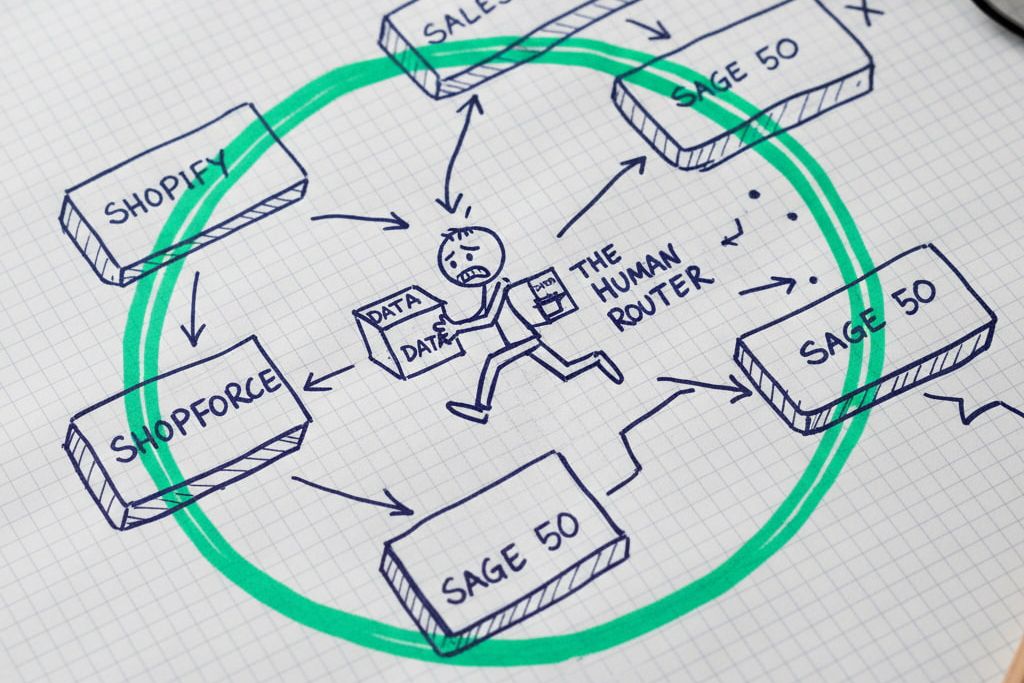
Look at their screen right now. They are exporting a CSV from Shopify, formatting the date columns in Excel, fixing the SKU mismatch from the warehouse system, and manually keying those adjusted figures into Sage 50.
Your operations manager is not managing operations. They are a human router.
They are highly paid middleware, manually transferring packets of data between disconnected silos. Every time a human touches a data pipeline to perform a repetitive task, two things happen. First, the probability of an error approaches absolute certainty. Second, your capacity planning is effectively capped by the typing speed of your staff. You cannot scale a business when your underlying architecture demands manual data entry to function.
The Duct-Tape Delusion
The standard industry response to this fragmentation is to slap Zapier or Make.com across the chasm. This is treating a gunshot wound with a plaster.
Third-party automation tools are fantastic for simple, stateless notifications. They are an absolute liability when handling complex, multi-stage financial or inventory transactions. When a Zap fails silently because Shopify changed an API endpoint or Sage 50 timed out, nobody knows. You just lose the data. This creates a terrifying scenario of eventual consistency, where your dashboard says you have inventory, your warehouse says you don't, and your accounting ledger has no record of the transaction.
This is not a technology problem. It is a structural failure. You are trying to force off-the-shelf software to accommodate highly specific, complex B2B workflows.
The Fix: Modular Monoliths and Bi-Directional Synchronisation
To permanently eradicate this margin leak, we have to fundamentally rethink the architecture. We must move away from renting twenty different micro-tools and return to a principle of centralised business logic.
We need to build a self-hosted modular monolith.
Instead of relying on third-party triggers and fragile webhooks, I engineer bi-directional synchronisation engines that sit directly between your core platforms. If an order drops in Shopify, the system instantly validates the stock, decrements the warehouse inventory, allocates the tax code, and posts the reconciled journal entry directly into Sage 50.
No CSV exports. No manual formatting. Zero-touch publishing.

By consolidating these disparate workflows into a single, custom-built, KPI-driven system, we achieve three unshakeable outcomes:
- Margin Protection: We eliminate the software bloat and the hidden labour costs of manual data entry.
- Absolute Truth: Your data is no longer scattered across five different dashboards. You get a single, uncorrupted view of your operational reality.
- Capacity Expansion: Your operations team stops acting as data routers and returns to doing the actual thinking required to grow the business.
SaaS consolidation is not just an IT exercise. It is a direct injection of operational leverage.
The Anti-Pitch
You don’t need more software. You need to know exactly where your current architecture is bleeding cash.
I built a diagnostic system to identify this exact margin leak. I call it the Inventory & Operations Health Checker. It’s a simple tool: you drop in your raw CSV exports, and it instantly flags the data mismatches, silent failures, and manual bottlenecks hiding in your workflow.
It takes three minutes to run. It will likely find where your team is wasting twenty hours a week.
Take it. Run the audit. See the leak for yourself.